| |
 |
My
Custom GPS Clock
For
many years I had wished to get an accurate
clock that I could trust, a clock that would
set itself and always be on time. I own an
"atomic" clock (WWVH-derived) but in
Eastern-Canada we are a bit on the fringe in
terms of WWVH radio reception, especially if
the clock is located in the basement. I needed
a better solution. So I decided to make my own
accurate clock based on a plain vanilla GPS
unit, which will always provide the right
time. Nothing outstanding here, but the end
result is quite satisfactory.
The intent I have with this page is to give you ideas on how to make your own accurate GPS clock, as opposed to giving you a spoon-fed recipe. Please contact me if you need more info.
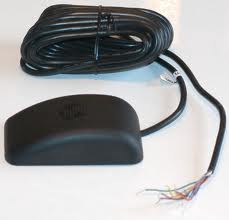
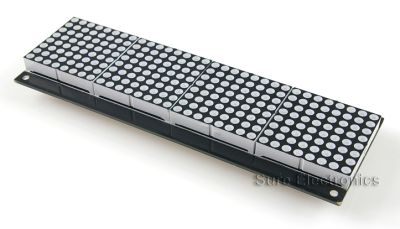
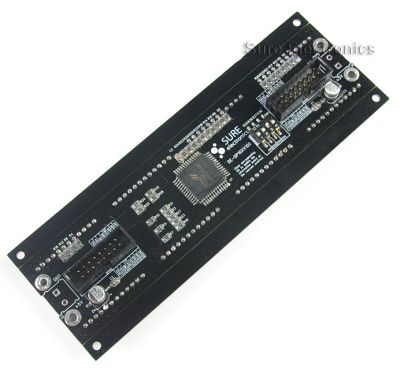
Here is what I used to put it together:
The following is a block diagram that shows how the devices are interconnected to create the GPS Clock. 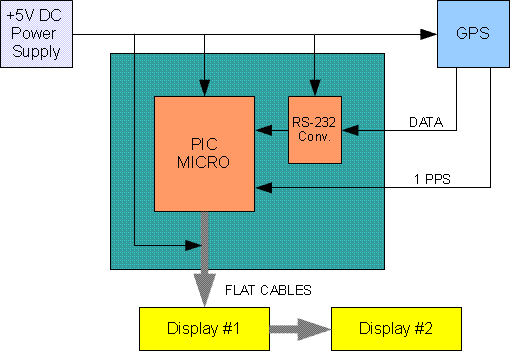
Of course, the bulk of the work was to write the PIC firmware to decode the NMEA text strings and update the LED display accordingly. Here is the C source code I wrote: The firmware triggers its display update with each pulse on the 1 PPS GPS output. Since the NMEA data comes in late compared to the 1PPS (it is sent during the current second), the PIC has to add one second to the previous second's NMEA data in order to display the accurate time as soon as the PPS pulse comes in. The firmware looks for the $GPRMC sentence. This sentence is normally enabled by default on most GPSs. I also disabled other sentences so that only that sentence gets sent; Less junk to filter out! The display shows the pseudo-Julian date (ordinal date or day-of-year) and UTC time, like the real astronomical clocks. A second hand feature, a small walking dot at the bottom of the display, shows the progress into the current minute by propagating from left to right.
The
following
short video shows the clock working, with
some CHU radio station audio in the
background. Any delay seen between the
display updates and the time ticks is a
video capture artefact. Things line up
perferctly in real life! Notice the walking
second dot at the bottom of the display.
|